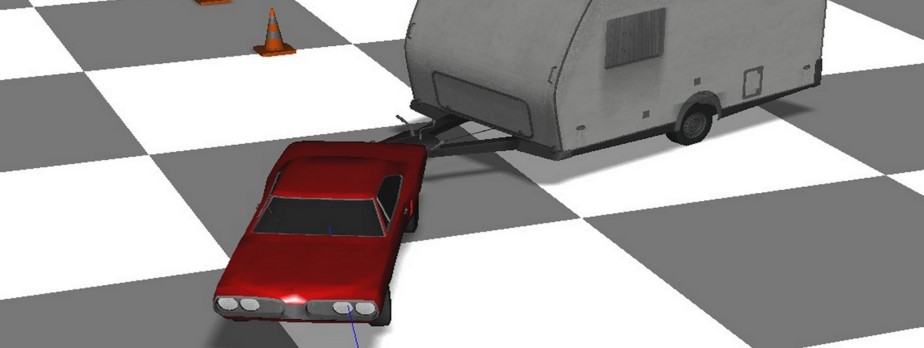
Automatic Trailer Parking
Automatic Trailer Parking in vsTASKER is a software solution that uses logical rules and algorithms to simulate a vehicle automatically parking a trailer or semi-truck in reverse without manual driver intervention. It uses automated driving models to manage steering, angle limits, and direction control.You can break down how it works into a few core mechanics:Logic Rule System: The software maps out a gate point in front of the parking spot, then uses algorithms to decide when to correct, reverse, or straighten the trailer.Angle Limits: It constantly calculates the turning radius to avoid crossing the dangerous "jackknife" threshold while backing up.Automated Driving Tasks: Special functions like Cornering and CtrlDirection direct the trailer toward the target spot while maintaining the correct angle.Vehicle Simulations: It can simulate various complex vehicles, from standard cars to multi-axle semi-trucks, allowing engineers to test autonomous parking designs in a safe digital environment.To learn more about the technical details of the simulation rules, you can review the full Automatic Trailer Parking Project breakdown.Would you like to know more about:How to set up a simulation from an empty database?The specific control loops used for reversing and cornering?How to build 3D vehicle models in the software?
Automatic Trailer Parking from vsTASKER is a specialized simulation algorithm designed by VirtualSim to create a set of automated rules allowing an automaton (AI driver) to park small or long trailers hooked to cars or trucks. Reversing multi-body vehicles is highly complex, and this framework replicates the spatial awareness and driving skills required for perfect execution.The algorithm relies on structural geometry, target positioning, and control loops to operate seamlessly without jackknifing.Core Logic & Spatial GeometryThe automation relies on positioning three specific alignment points alongside the vehicle:The Gate Point: A temporary point created at a safe distance from the parking lot, aligned directly with it. Testing shows the optimal placement is roughly two times the length of the trailer.The Lot / Target Point: The final intended parking spot for the trailer.The Control Loop: Relies on the vehicle's turn radius and real-time physical constraints.The 3 Core Execution RulesThe algorithm executes the parking sequence based on three algorithmic rules:Alignment Check: If the distance to the gate point is too tight, or the vehicle's turning radius is incompatible, the moveAway function triggers. This pulls the tractor 15 meters forward to recalculate and find the ideal line.The Trigger Condition: When the system confirms alignment, it executes the following logic script:if (gate_point and distance(trailer, gate_point) > turn_radius and vehicle.getSpeed() == 0) then reversePark(gate_point, lot);Active Maneuver Control: The final reversePark script relies on two simultaneous tasks:Cornering: Reverses the trailer toward the gate point, keeping the widest possible angle between the tractor and trailer shafts without crossing the jackknife threshold.CtrlDirection (Control Direction): Maintains a flat, constant trailer heading. This task is logic-capped to only activate if the trailer heading is inside a 15° range from the target heading.Underlying Framework Technical RequirementsTo run or develop this simulation within the VirtualSim ecosystem, the project utilizes:vsTASKER: To model the logic engines, scenarios, and vehicle rulesets.OpenSceneGraph: The primary 3D graphics rendering engine.Axle / AxleDyn Component: A bespoke physical component utilized to accurately simulate chassis physics, steering mechanics, and articulation constraints.
Reference image showing features of vsTASKER
Reference video showing features of vsTASKER
Automatic Trailer Parking (The Use Case)This is a consumer or industrial feature designed to help drivers reverse and park vehicles (like RVs, caravans, or semi-trucks) with trailers attached.How it works: It uses sensors, cameras, and automated steering to control the trailer's difficult pivot points, preventing "jackknifing".User Experience: The driver usually selects the parking spot on a screen, and the system takes over the steering while the driver manages the brakes and throttle.Goal: Remove the stress, blind spots, and skill required for backing up multi-part vehicles.
Downlaod - Automatic Trailer Parking
Request for Trial licence
Download User Guide & reference manual
vsTASKER (The Simulation Environment)vsTASKER is a visual simulation tool developed by VirtualSim that engineers use to build and test autonomous driving features.How it works: It creates virtual 3D environments, physics (like axle movement), and "automatons" (sets of logical rules) to replicate real-world vehicle behaviors.Use Case in Parking: Engineers use vsTASKER to program the exact algorithms required for automatic parking and watch the virtual trailer park itself safely before writing it to actual hardware.Goal: Safe, fast, and risk-free testing of edge cases (e.g., tight corners, bad weather, multi-axle trailers) without damaging real vehicles.How They Compare