Process Control SCADA Tool
The GLG Toolkit by Generic Logic, Inc. is a highly flexible, cross-platform graphical framework used to build real-time visual interfaces, Supervisory Control and Data Acquisition (SCADA) mimic diagrams, and Human-Machine Interfaces (HMI) for industrial process control.Key ComponentsGLG Graphics Builder: A point-and-click interactive editor used to design dynamic HMI screens and dashboards without manual layout coding.Pre-Built Components: An extensive library of dials, meters, real-time charts, avionics gauges, and process control widgets.GLG Object Engine: A high-performance graphics engine that optimizes screen updates by only refreshing elements affected by changed data.Multi-Platform Supported EditionsThe GLG Toolkit runs on Windows, Linux/Unix, and real-time operating systems:Web Edition: Supports client-side web and mobile deployment using JavaScript with plain HTML, or frameworks like React, Angular, and Next.js. It also provides an ASP.NET or JSP Graphics Server for server-side processing.Desktop Editions: Includes native integrations via C/C++ DLLs, Java Class Libraries, and a .NET Edition (featuring a C# User Control and class library) to embed screens into standalone apps.Embedded Edition: Provides lightweight footprint support for ARM-based boards (such as Raspberry Pi, NVIDIA Jetson, and TI Sitara) running on ThinClients.Industry ApplicationsIt is widely implemented in mission-critical environments including telemetry tracking, traffic control, network monitoring, and automation systems. Notable users include NASA, the FAA, Collins Aerospace, and Yokogawa.Are you looking to use the GLG Toolkit to design a new SCADA dashboard from scratch, or are you trying to embed it into an existing application (e.g., using C#, Java, or JavaScript)?

How the GLG Toolkit WorksThe toolkit simplifies the software development lifecycle for process control through several core components:GLG Graphics Builder: A point-and-click graphical editor that allows users to draw custom HMI elements and define their logic and behaviors without writing code.Data-Driven Dynamics: Drawings are bound to backend data sources (such as PLCs, OPC servers, or REST APIs) using Data Tags. As the data changes, the graphics update instantly.Infinite Scalability: The visual elements are vector-based, ensuring they render perfectly whether displayed on a compact embedded screen or a high-resolution command-center video wall
The GLG Toolkit by Generic Logic is a high-performance, cross-platform graphical development framework used to build visual interfaces for Process Control, HMI (Human-Machine Interface), and SCADA systems.Unlike standalone, out-of-the-box SCADA software platforms, it functions as a highly flexible development framework designed to embed dynamic data-driven graphics into custom or existing industrial applications.Core Technical CapabilitiesInteractive Graphics Builder: A point-and-click HMI editor allows developers to draw custom mimics, define dynamic behavior (e.g., color changes, flashing, rotation), and map real-time industrial data sources without hand-coding the vector graphics.Pre-Built Component Libraries: Includes fully customizable industrial widgets such as dials, meters, high-density trend charts, toggles, and process control symbols (valves, pumps, pipes, and tanks).High-Performance Architecture: Optimised for low-latency telemetry, enabling smooth animations and real-time updates for charts tracking tens of thousands of continuous data points simultaneously.Integrated GIS Mapping: Features an optional self-contained GIS Map Component that can run locally on an isolated network without requiring external internet-based tile servers.Comparison of Deployment EditionsThe framework allows developers to create a visual asset once in the Graphics Builder and reuse it identically across multiple programming environments:EditionRuntime EnvironmentBest Used ForWeb & MobileJavaScript, React, Angular, Next.jsZero-install web browser dashboards and remote operator screens.C# / .NETWindows Forms, C# Class LibraryTraditional native Windows enterprise desktop SCADA architectures.C / C++Cross-platform DLL / Shared LibrariesHigh-performance Unix, Linux, and Windows mission-critical systems.JavaJava Class LibraryCross-platform desktop monitoring applications.EmbeddedARM architecture support (ARMv6 to ARM64)Small footprint ThinClients, Raspberry Pi, and edge computing boards.
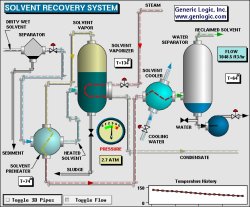
Reference image showing features of GLG Toolkit
Key Use Cases in SCADA and Process ControlThe toolkit is heavily utilized for several specific functions in automation and mission-critical applications:Live Process Mimics & Flow Diagrams: Visually representing physical operations like manufacturing lines, oil pipelines, or water treatment plants using animated pipes, valves, and tank levels.Control Room Dashboards: Providing continuous, low-latency visual data for operators to monitor and control industrial machinery.Alarm and Event Management: Animating objects (e.g., changing colors to red, flashing) or triggering visual indicators based on incoming data tags that denote faults, warning limits, or system failures.Trending and Charting: Displaying real-time charts (strip charts, bar graphs, dials) so operators can track physical variables like pressure, temperature, and voltage.Network & Telemetry Monitoring: Mapping and visualizing remote stations, traffic grids, or communication networks

Download s-Process Control SCADA Tool
Request for Trial licence
Download User Guide & reference manual
Industry Use CasesBecause of its extreme reliability and speed, the toolkit is heavily favored in demanding sectors by large entities like NASA, FAA, Collins Aerospace, and Yokogawa. Key applications include:Industrial Automation: Real-time tank, motor, and chemical process supervision.Power & Utilities: Dynamic wind turbine output and electrical grid sub-station monitoring.Telecomm & Networks: Network topology maps and traffic congestion interfaces.If you are evaluating this tool for a project, tell me:What programming language or framework (e.g., C#, React, C++) is your primary SCADA system written in?What types of data sources or protocols (e.g., OPC UA, Modbus, MQTT) do you need to map to your visual components?