Radar raw data Simulation
Radar raw data simulation is the process of mathematically generating the physical signals—like electromagnetic waves, I/Q data, or specific dB values—that a radar receives from targets and the environment. vsTASKER is a software used to build virtual environments, manage scenarios, and direct the movement of entities (like aircraft or ships) in those environments.These two concepts work together to create realistic radar training systems.vsTASKER's Role: The Scenario DirectorIn a radar simulation, vsTASKER acts as the command center. It manages the rules of the virtual world.Entity Control: vsTASKER controls the paths, speeds, and actions of all objects (targets, jammers, drones).Environment Setup: It sets the geographical areas using digital maps, terrain data, or maritime charts.Logic & Triggers: It defines how objects behave, such as how an aircraft maneuvers to evade a radar.Radar Raw Data Simulation: The Physics EngineRaw data simulation calculates the actual physics of how a radar beam hits an object and bounces back, rather than just drawing a dot on a screen.Signal Generation: It creates the actual electronic signals, such as chirps or pulse Doppler returns, affected by terrain clutter and noise.Target Details: It calculates the Radar Cross Section (RCS)—how visible an object is to radar—and its Doppler frequency shifts.Visualizing the Signal: Specialized tools (like vsRAD) process these signals into the traditional images seen on radar operator screens (like PPI or A-scopes).How They Work TogetherThese systems are usually combined to create advanced training and testing tools.vsTASKER tells the target aircraft to fly across a specific airport or sea area.The Radar Raw Data Simulator calculates how the radar beam hits the aircraft and simulates the exact radio waves bouncing back.The radar screen displays the signal return, allowing operators to train or engineers to test radar equipment.If you are working on a specific type of radar, could you tell me whether you are focusing on Air Traffic Control (ATC), Maritime Surveillance, or Defense/Electronic Warfare? I can explain how these systems are typically configured for your industry.
vsTASKER handles radar raw data simulation by acting as the tactical scenario engine that manages entities, movements, and environments, while offloading the physics-heavy raw signal calculation and visualization to external specialized modules.Rather than generating complex IQ or radio-frequency (RF) waveforms directly, vsTASKER by VirtualSim provides a C++ code-generation framework to orchestrate the radar's state and communicate with dedicated radar simulators.How the vsTASKER Radar Simulation Pipeline WorksIn a typical radar raw data simulation setup, vsTASKER operates alongside external engines (like OKTAL-SE or VirtualSim's own vsRAD library) through a three-tiered pipeline:[ vsTASKER ] --------------------> [ Physical Physics Engine ] ---------> [ vsRAD Toolkit ]
(Scenario & Entity Motion)          (e.g., OKTAL-SE C-Band Simulator)     (Raw Data Import & HMI)
  - Positions the radar platform      - Illuminates 3D databases            - Converts dB raw data
  - Controls target trajectories      - Computes raw dB per angle/range     - Blends static background
  - Outputs Azimuth & Distance        - Models Radar Cross Section (RCS)     with real-time targets
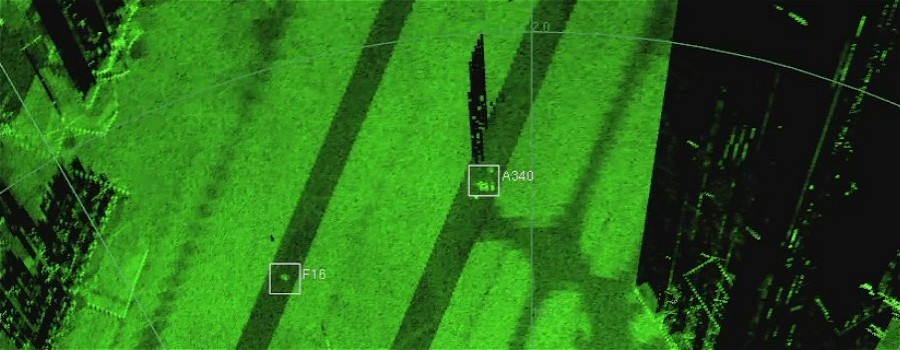
Scenario Orchestration (vsTASKER): vsTASKER manages the tactical environment. It handles high-entity environments (such as drones or aircraft), defining the radar platform's exact location, the targets' movements, their orientations, and their trajectories.Raw Data Generation (Physics Layer): When an entity enters the radar's field of view, its positional data is fed into a physical modeling engine (e.g., OKTAL-SE). This layer computes the physical interaction—calculating received decibels (dB) per angle and range based on the target's Radar Cross Section (RCS) and a 3D terrain database.Visualization & HMI Display (vsRAD): The generated raw signal data is streamed into vsRAD (VirtualSim's radar visualization toolkit) via shared memory. A dedicated algorithm converts the raw data into an adjustable graphical image (PPI, AR, or B-Scope modes), overlaying the moving target's dynamic signal footprint onto a static environment background in real-time.Key Capabilities in Radar ContextsBatch & Monte Carlo Testing: vsTASKER can run millions of automated batch scenarios to generate raw radar data for statistical analysis, performance tracking, and training AI data-fusion architectures.High Entity Scaling: The software is designed to handle heavy loads, letting you test how data processors and radar sensors scale when tracking thousands of simultaneous radar returns.Multi-Sensor Simulation: Beyond basic surveillance radar, users deploy vsTASKER alongside custom physics models to simulate Synthetic Aperture Radar (SAR), Moving Target Indication (MTI), and Electronic Warfare (EW) environments.Are you planning to build a hardware-in-the-loop (HIL) radar testbed, or are you looking to generate synthetic datasets for machine learning training? Knowing your end goal will help me provide more specific implementation steps.
Reference image showing features of vsTASKER
Reference video showing features of vsTASKER
Core Use Cases for Radar Raw Data SimulationAlgorithm Validation: Testing radar signal processing algorithms (like Range Cell Migration Correction or Range-Doppler processing) using synthetic IQ/raw data.RCS (Radar Cross Section) Analysis: Calculating how a target's shape and material reflect radar waves to generate signature libraries.Sensor Design: Evaluating hardware parameters such as bandwidth, pulse repetition frequency (PRF), and antenna beamwidth before building physical prototypes.Clutter & Environment Modeling: Simulating terrain, sea states, and weather effects to check how well raw data filters out background noise.
Downlaod - Radar raw data Simulation
Request for Trial licence
Download User Guide & reference manual
Core Use Cases for vsTASKERPlatform Dynamics: Generating exact 3D trajectories, speeds, and orientations for airborne, maritime, or ground entities in real-time.Scenario Generation: Designing complex, multi-agent exercises (e.g., electronic warfare jamming, UAV swarms) for AI training and data fusion.Triggering Sensor Events: Providing the orchestration engine that tells the radar exactly when to sweep or illuminate a target, and where to send the target's parameters.How They Work TogetherScenario Setup: vsTASKER is used to define the boundaries of the mission, the geographic environment (via maps or charts), and the motion of all entities.Illumination: As an entity (e.g., an aircraft) enters the field of view, vsTASKER sends its current azimuth, distance, and orientation to the radar raw data simulator.Raw Data Generation: The physics module uses these parameters against a 3D terrain and target database (like a CAD model of an aircraft) to calculate the precise time-domain echo or I/Q data.Visualization: The computed raw signals are fed to a dedicated display and processing pipeline (such as the vsRAD module) to recreate the radar image.Would you like to explore how to integrate a physics-based radar simulator with vsTASKER, or are you more interested in the statistical analysis of the generated radar data?