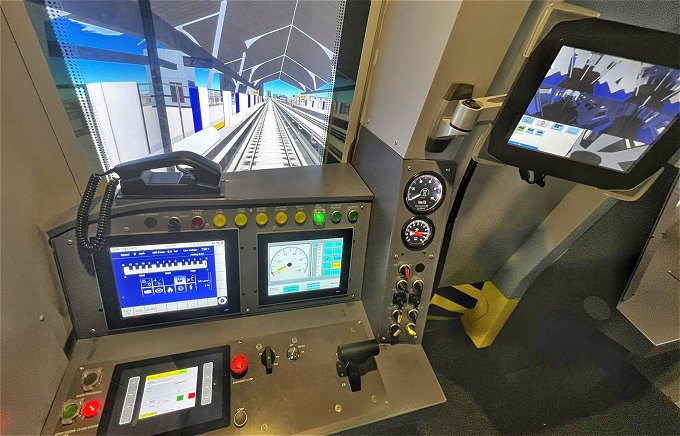
Train Cab Trainer simulator
There is no conflict here; instead of being competitors, vsTASKER and a Train Cab Trainer work together. A Train Cab Trainer is the complete hardware and software system used to train drivers, while vsTASKER is the core software tool (SDK) used to build the hidden "brains" of that simulator.vsTASKER (The Simulation Engine)vsTASKER is a professional simulation development toolkit created by VirtualSim.

The Brains: It is used by engineers to program the physical logic of the train, the rail network, signaling systems, and traffic rules.No Graphics: It does not render the pretty 3D world you see on the screens. Instead, it processes the math, scenarios, and commands in the background.Flexibility: System integrators use it to create specific training scenarios, like emergency situations or complex track switching.Train Cab Trainer (The Full Simulator)A Train Cab Trainer (or Metro Driver Trainer) is the complete system used to teach train operators how to drive.The Full Setup: It includes physical controls (levers, buttons, screens) and a visual 3D environment.System Integration: A full simulator combines many parts. It uses vsTASKER as the core engine to dictate how the train behaves on the tracks, a 3D engine (like VegaPrime) to display the windows, and physical hardware in a mock cabin.
vsTASKER runs on a server connected to the physical desk in the cabin.The trainee pushes a button or pulls a lever in the cab.This action goes to vsTASKER.vsTASKER processes the physics and train rules (e.g., speed limit, signal lights) and sends the position data to the 3D screens.It also manages the Instructor Station, allowing a trainer to inject faults, change the weather, or test emergency brake scenarios.

How vsTASKER is Used in Train Cab Trainers When developers use vsTASKER to engineer a Train Cab Trainer, they rely on it to handle the logic, data routing, and environment behavior: The Core Simulation Engine ("Trainsim Server"): vsTASKER acts as the central command architecture. It handles the train control-command logic, schedule execution, signaling rules, and the physics of the train. Hardware Integration (MQTT/LAN): Industrial cab trainers use real or replicated physical train controls (throttles, brakes, dashboards). vsTASKER connects to these physical cab components using communication interfaces like MQTT or network sockets.
3D Graphics Offloading: vsTASKER focuses strictly on logic and data. It passes positional and state data to specialized 3D rendering engines (such as VegaPrime) to display the tracks, weather, and surroundings across multiple visual channels/screens in the trainer cockpit. AI and Environment Traffic: It populates the training scenario with simulated smart entities—like automated traffic on neighboring tracks, pedestrian logic for passengers (sometimes linked with engines like DI-Guy), and unexpected track obstructions.Typical System Architecture of a vsTASKER-Powered Trainer  

[ Physical Train Cab Controls ] <---(MQTT / LAN Link)--->[ vsTASKER Engine ]
                 |                                                 |
         (Driver Inputs)                                   (Generates Logic,
                 |                                      Schedules, Traffic & Rules)
                 v                                                 v
   [ 3D Rendering (e.g., VegaPrime) ] <----------------------------+
                 |
                 v
   [ Out-of-Window Multi-Screen Display ]

it utilizes a graphical paradigm to model behaviors and features automatic C++ code generation. This allows developers to design complex rail networks, manage multi-station line timetables, and simulate real-time emergency injects (e.g., brake failures or track obstacles) without building a custom simulation infrastructure from scratch.
Reference video showing features of vsTASKER
The use case of a Train Cab Trainer using vsTASKER highlights how the C++ code-generation platform functions as the central logic and simulation engine for high-fidelity rail environments, real-time training. A breakdown of this specific use case demonstrates how vsTASKER powers a train cab trainer:

1. Core Simulation Engine (The "Brain")Instead of relying on commercial game engines, vsTASKER handles the complex, real-time backend calculations.Train Dynamics: It computes physics, multi-car mechanics, mass, and braking behavior.

Control-Command Logic: It mimics the real train’s onboard computers, interlocking systems, and signaling rules.

Route Logic: It drives the virtual train along complex rail networks while monitoring exact track positions.
Downlaod - Train Cab Trainer simulator
Request for Trial licence
Download User Guide & reference manual
Hardware and Cab Integration A full cab trainer requires physical controls (throttles, brake levers, status screens, and switches) to respond in real time.MQTT & Network Communication: vsTASKER connects directly to the cabin's hardware components over lightweight networks like MQTT to synchronize input and outputs seamlessly.Motion Platform Linkage: For physical cabs mounted on six-degree-of-freedom (6-DoF) motion bases, vsTASKER sends dynamic force and movement data to the motion controllers. This simulates tracking, derailments, and emergency braking.